When lunch comes home uneaten
Lunchbox Coming Home Full? How to Pack for a Short Lunch Period
Before replacing tomorrow's menu, ask what happened at lunch. Could your child open the container? How much time did they have once they sat down? Did the food feel different from the way it does at home?
A full lunchbox is a reason to investigate, not proof that you packed the wrong food. Sometimes the useful change is a different lid or a peeled clementine, rather than a new recipe.
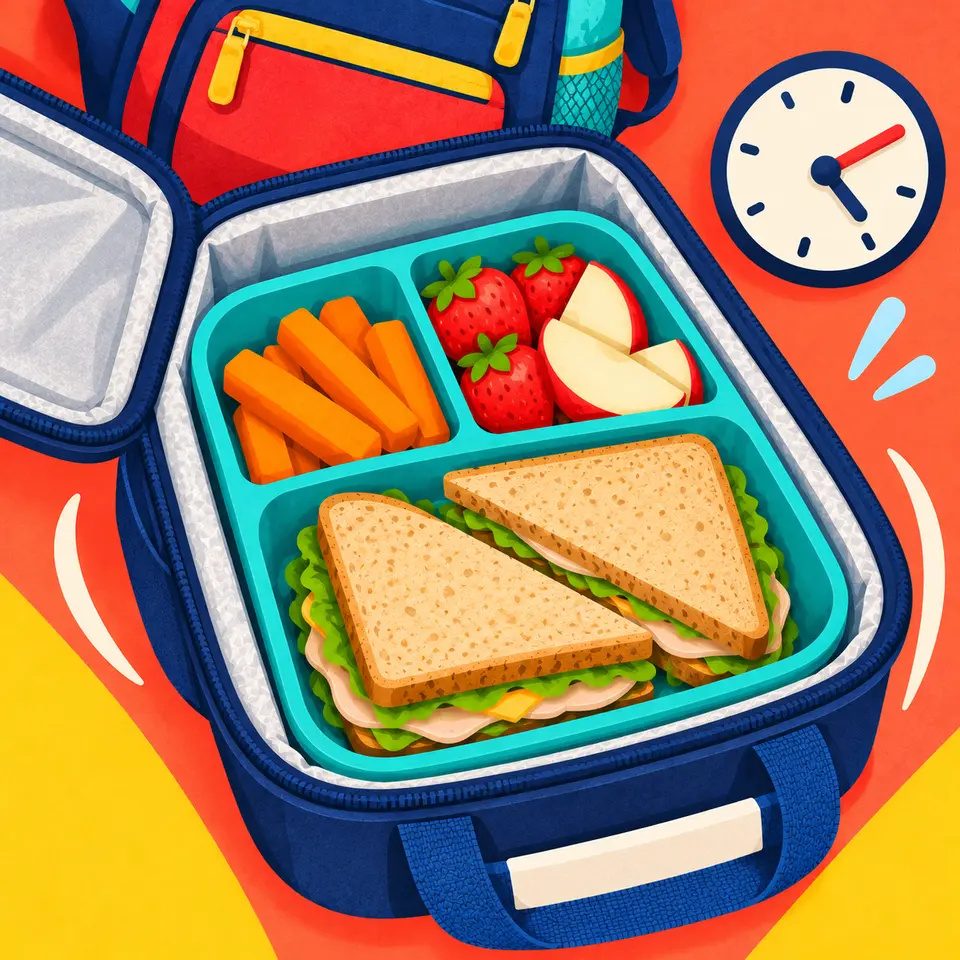
Look at seated eating time, not just the timetable
CDC recommends at least 20 minutes of seated time for students to eat and socialize. The total lunch period can include walking, handwashing, lines, and clearing up, so a longer period on the timetable doesn't necessarily mean that much time with the lunchbox open. CDC's school-lunch guidance
It also gives you a useful question to ask the school: “How much seated eating time do they usually have?”
The goal is to remove obstacles and protect eating time—not teach a child to rush or take bigger bites.
Start with a few ordinary questions
Try “Was there anything you couldn't open?” or “Which part did you get to first?” You might learn that the lid was tight, the spoon was missing, or the sandwich had become soggy.
Ask whether the food was still enjoyable at lunchtime, too. A food your child likes fresh from the kitchen may be a different experience after being packed.
For a few days, note one practical observation rather than grading how much came home. Change one thing at a time so you can tell whether it helped.
Make the food ready to eat
Try peeled clementine segments, a sandwich cut into manageable pieces, or a spoon already tucked beside the yogurt. Keep dry cereal away from yogurt until eating time when your child prefers it crunchy.
Choose the amount and number of containers for the child, not for a lunchbox photograph. Fewer packages can mean fewer opening jobs, but there isn't a correct item count for every lunch.
For children under 4, and older children who still need it, chop round, firm foods such as grapes into tiny pieces, no larger than half an inch, and adapt other firm foods to their chewing skills. AAP choking-prevention guidance
A snack-style lunch can still work. If arranging crackers and toppings is taking too long, let your child eat the parts separately or prepare the combination ahead.
For fruit that comes home because it looks different, see keeping apple slices from browning.
Rehearse opening the lunchbox
Have your child try the actual containers at home. Check lids, wrappers, bottle caps, and the food jar—not just the outer lunchbox.
If a package is difficult, consider a clean, secure container your child can manage. Don't solve an opening problem by leaving a perishable food partly open in the bag. Keep it properly covered and chilled.
Tell your child who they can ask for help at school. A different container may help, but an adult nearby is part of the plan too.
Let the arrangement help, without controlling every bite
Make the food and utensil easy to see and reach. You don't need to hide a treat or turn the meal into an instruction to finish one food before another.
Start with familiar foods and talk about what your child would like to choose next time. Johns Hopkins suggests letting children choose from a list of foods you approve and saving new foods for meals at home.
If the same food repeatedly returns, ask about it before packing a bigger portion. The issue might be appetite, texture, time, or a preference that changed.
Handle leftovers separately from feedback
You can learn from what was left without saving it to eat later. Discard perishable leftovers when you cannot verify safe holding. The two-hour limit outside temperature control becomes one hour above 90°F; do not use smell or appearance to override it. FDA handling guidance
Unopened shelf-stable foods are a different case: follow their package instructions. For the next day's setup, use the cold-lunch guide.
When a packing adjustment isn't enough
If time or access is the problem, speak with the teacher or school about opening help and seated eating time.
If your child persistently struggles to eat, chew, or swallow, has growth or weight concerns, or becomes very distressed around meals, speak with their pediatrician or a qualified feeding professional. Nationwide Children's lists these among the signs that a feeding evaluation may help.
Keep tomorrow's choice manageable
Lunch Crew lets your child choose ahead from foods you've made available. That can make the packing plan clearer while you work out what is happening at lunchtime. The goal is a useful conversation and a workable lunch—not an empty box at any cost.
Sources and review notes
Prepared by Lunch Crew. Source review: October 27, 2026.