Kids can help
How to Teach Kids to Pack Their Own School Lunch
Start with one job your child can manage: choose a main, fetch a spoon, or put a packed snack into the lunch bag. Do it together, repeat it, and add another step when they are ready.
Some parents pack every lunch; some children handle much of it themselves. Both can work. This guide is for sharing the job a little more—not setting a deadline for independence.
Let your child start with the choices
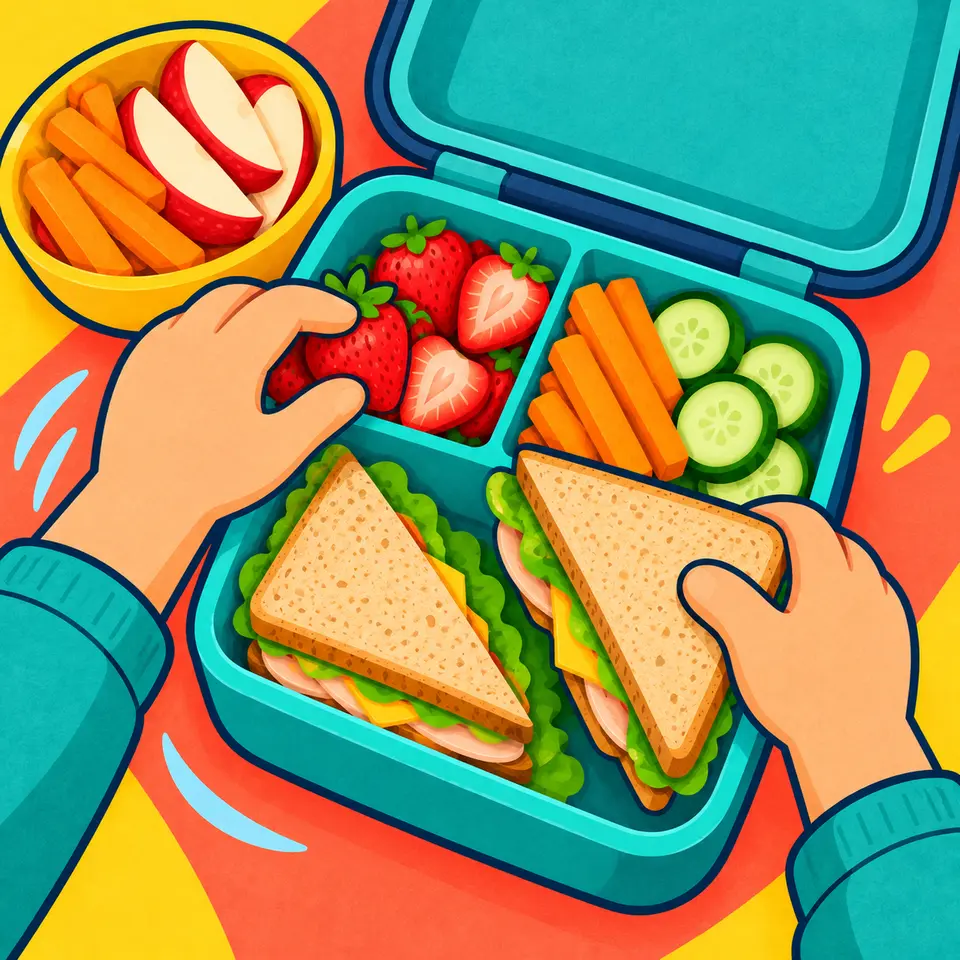
Offer a small set of foods you have already decided are available: “Bagel or cheese sandwich?” Then choose the fruit, vegetable, sides, and drink that fit the plan.
You don't need to hand over the entire menu at once. Choosing one day ahead is a reasonable starting point. Letting children choose from a parent-approved list is also part of Johns Hopkins' school-lunch advice.
Keep choosing separate from the safety decisions. The adult still checks ingredients, school rules, food preparation, and storage.
Make the job possible to follow
Put suitable supplies within reach and use containers your child can open and close. A lunch packing station can be a shelf and drawer, not a new set of matching bins.
Keep the plan where your child can see it. Use words, pictures, or a checklist according to what helps them. Demonstrate the task once, then try it together rather than expecting the instruction “pack lunch” to explain every step.
Prepare foods appropriately before making them self-serve. For children under 4, and older children who still need it, that means chopping round, firm foods such as grapes into tiny pieces, no larger than half an inch. AAP choking-prevention guidance
What might fit at different ages?
Use these as starting points and adjust for your child's skills, attention, confidence and any support needs. An older child can start with the first group of jobs, too.
Scroll sideways to read the table.
| Rough starting point | Tasks to try together |
|---|---|
| Ages 5–7: choose and gather | Choose between approved foods, fetch a clean container, add a ready-portioned side, find a napkin and utensil. |
| Ages 7–9: follow the routine | Work through a checklist, assemble a familiar simple sandwich with suitable tools, check that lids close, and empty the bag afterward. |
| Ages 9–12: help plan and prepare | Look ahead at several lunches, note missing groceries, follow a familiar recipe, or practice chopping with adult supervision. |
The Academy of Nutrition and Dietetics notes that skills vary within each age group and that kids 9 to 12 should still have adult supervision in the kitchen. Let readiness lead.
A checklist for a cold packed lunch
This version separates getting ready from leaving the house, so cold food does not end up waiting beside a backpack.
Get ready
- □ Wash my hands.
- □ Check today's food plan with my grown-up.
- □ Set out my clean lunch bag and containers.
- □ Gather the shelf-stable foods on my plan.
- □ Add a napkin and the utensils I need.
- □ Keep cold foods in the refrigerator while we are still getting ready.
When it is time to leave
- □ Add the cold foods and at least two frozen cold sources, one above and one below them, in my insulated bag.
- □ Check the drink and close the containers.
- □ Have my grown-up check the food, packing, and lids.
- □ Take my lunch with me.
Print the one-page kids' cold-lunch checklist. It has space for today's plan and an adult-check reminder. The cold-source instructions follow USDA guidance.
Hot lunches need a different sequence; use the food-jar guide, with an adult handling boiling water and reheating.
Jobs an adult still owns
Food safety remains an adult responsibility even when a child handles the containers. Check labels and the allergy plan, adapt food shapes and textures, verify cold storage, and supervise knives or other tools until their use is appropriate for that child.
Do not make remembering a cold pack the child's only protection against an unsafe lunch. Check the finished bag together. The Academy's food-safety guidance for young cooks is a useful starting point for these shared routines.
Build the habit without turning it into a test
Choose a day with enough room to practice. If the morning becomes rushed, take over the remaining steps and try again another day.
Notice a specific action: “You checked the plan before getting the food.” If something was missed, work out which reminder would help. You are teaching a sequence, not assigning a grade to the lunch.
After school, a child can help empty the bag, put reusable cold packs back in the freezer, and bring containers to the washing area, with help as needed.
One plan, whoever packs
Lunch Crew gives children a way to choose ahead from parent-approved foods, and keeps the packing plan available for the family. Parents can pack, kids can help, or the job can be shared. The choices do not need to be remembered by only one person.
Sources and review notes
Prepared by Lunch Crew. Source review: October 27, 2026. The lunch-packing age bands are practical suggestions, not developmental requirements.